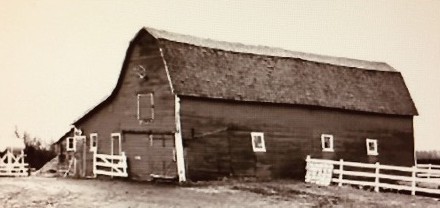
In 1974, Walter’s brother-in-law Donald Kauffman, who was teaching Grade 5 in Edmonton, presented his students with a photo of the old barn and asked them to write about it. The resulting stories were given to Walter. He responded with the following:
Dear students of Mr. Kauffman:
I enjoyed all your compositions. Some of you were very close in your ideas of the owner of the barn, some were rather far out, but I still enjoyed them all. Some of you have very fine imaginations and ideas and that’s good.
Anyhow, to answer all your remarks, I finally decided to let the old barn tell its story to you, at least as much of it as I know. So here goes:
Yes, I know I look old and dilapidated now, but I’ve felt the force of a thousand storms. The frost of over 50 winters has cracked my boards and loosened my nails, the hail has broken some of my windows, torn off my shingles and paint, and driving rain has rotted my west and north walls. But I can be proud of the service I’ve given. Once I was just like you are, young and strong, straight and healthy.
I was born, you might say, in 1919. A young fellow from somewhere in the States started me, came to Alberta to seek his fortune on a homestead. I was shorter then, just 16 x 24, with three double horse stalls, and storage for a buggy and a cutter. That was my purpose then. In 1925, my builder sold the farm to the grandfather of my present owner and returned to the United States. The rigours and discouragements of farming were just too much for him. In 1926, my new owner and his son tore out my north wall and doubled my length to 48 feet. Then they added a lean-to on the west side—16 feet more—a barn for milk cows and room for six teams of horses or five teams and a stallion stall. Times were hard then. They were immigrants from Europe just starting out in Canada, so they built the addition on stones, not cement. I knew it was a mistake then, but what could I do? But then I stood straight and tall, bright and proud with paint. On my north wall it said “J. Lutz and Son, 1926” and I was very proud.
Through the years I have seen much, for much has happened within my walls. I have been a refuge in storm for men and children as well as cows, horses, pigs at times, and even chickens, and that’s not counting kittens, cats, dogs, and pups.
In the fall, the teams of threshers rested in my stalls while men slept in my hayloft. Yes, I heard coarse jokes, but the men were all good-hearted and hard-working. Some of them were only 16 or so and slept in my loft the first autumn that they became men and joined the threshing crew.
All summer, the wild prairie and slough hay was carefully pitched into my loft. What a lot of work that was. But inside my walls, the hay was always safe from the weather and ready for the long, long winter and the cows and horses below.
In stall #6 in the horse barn was the stallion, Percheron, black with a white star and two rear white socks. My, how he could scream and whinny when the other horses came or went. His stall had extra heavy 2 inch boards on the sides and he was tied with a heavy halter and rope. During the busy spring season, it was the job of the wife to do all the chores while the men were busy in the field. One of the chores was to lead the stallion to the water tank. How she disliked and feared this job: he seemed so big and powerful and he always whinnied a loud scream as soon as he finished drinking. He always frightened her, even though he was generally well-behaved.
I remember all the colts that were born and trained in my walls. But I remember some sad things, too, like that colt born in 1943 or ’44, I can’t remember which exactly. What a pretty filly—mouse-colored with white blaze and legs—but the legs splayed out in every direction. I saw the owner, now the son, help the colt to nurse, to help it stand, to make it walk, to no avail. I heard the children cry when they knew what must be done, and then I heard the report of the rifle on the west side, and I saw the mare paw the stall, quiver and cry as though she too knew what had happened. But Alberta can be very cruel; I’ve felt it, I know, and only the strong can survive.
I’ve seen men cry too within my walls. Cry in frustration at the hail that ruined their crops and spoiled their plans, especially the bad one of 1933. It hurt me too, but I cannot cry.
I was a castle and a fort and a playhouse for children throughout the years. Where’s a better place when it’s raining or when all the cousins come on Sundays? There were 50 good places to hide in me when they played hide-and-seek; they jumped on the hay in my loft, made forts and played their imaginary games there. It was a good place to hide from father’s or mother’s wrath too, at least till it subsided a little. It was also a good place to go by oneself just to think and contemplate, or even take a nap. My walls are full of writing— initials of school-time sweethearts, names of hockey players long forgotten, dates when cows were bred and calves were born.
Through the years, progress in agriculture changed my features. The slow demise of the horse meant some of the horse stalls became stalls for calves and pens for brood sows. I did not like the smell of pigs in me, and it was hard on my pride.
In 1952, electricity became available in my district and bulbs now clearly lit my stalls instead of the dim lanterns. Electricity milked the cows too, instead of the smoking, chugging troublesome engine, which once itself was a miraculous improvement over hand milking.
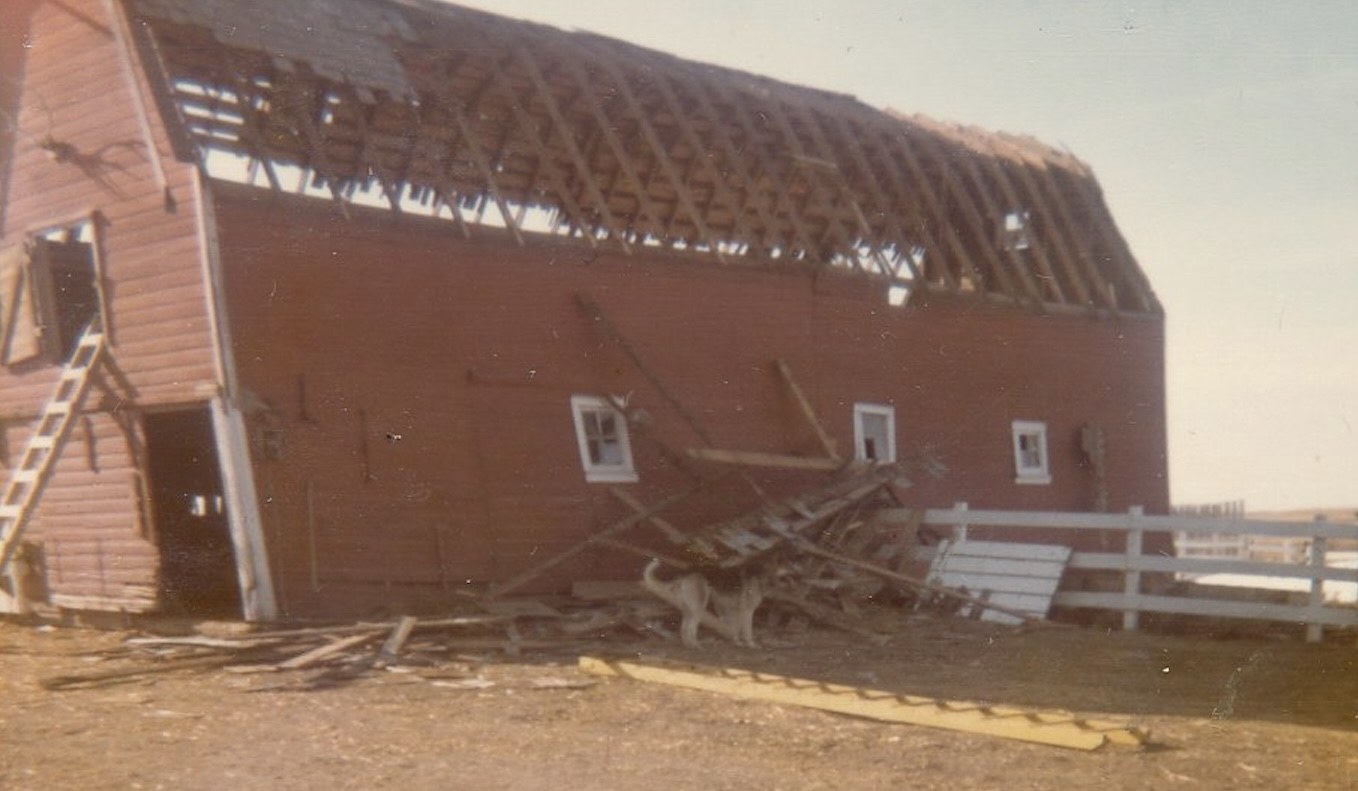
Then came bales instead of loose hay. Load after load of bales were stacked carefully into my loft. How I wished I could say something. Say that my walls and loft were never made, never built, for the tons of hay now stored there. Bales were breaking my back, slow but sure. I began to slide off some of the stones on which I was built. That vicious northwest wind began to push me to the southeast. There was nothing anyone could do. My shingles became thin and a few more were missing after every big storm. I was suddenly old, no longer a barn, just a shelter, just a sick bay in an emergency, a reminder of the past.
But I had done my share. I was shelter from rain and frost, wind and driving snow, shade from the burning sun, refuge from the ever-present mosquitoes and flies, storage for harnesses and saddles, hay and bedding. I may have even saved lives—impossible though you may think that may be. I remember that day in March 1946 or ’47. The children had gone to school two miles away in the cutter and horse as usual, when the storm struck in a frenzy shortly after dinner. All the children left for home, in a blinding blizzard. When it became impossible to see where they were going and to guide their faithful old horse, the children remembered their father’s instructions for a case like this: “Just let Goldie go where she wants to. She knows the way home.” And know the way home she did, because she remembered my warm walls and her dry stall. She remembered the sweet green hay in the manger and the oats in her chop box and so she brought home four frightened little souls to a joyful, crying mother and a grateful father. And I helped, I know I did, even though no one ever thought about it then.
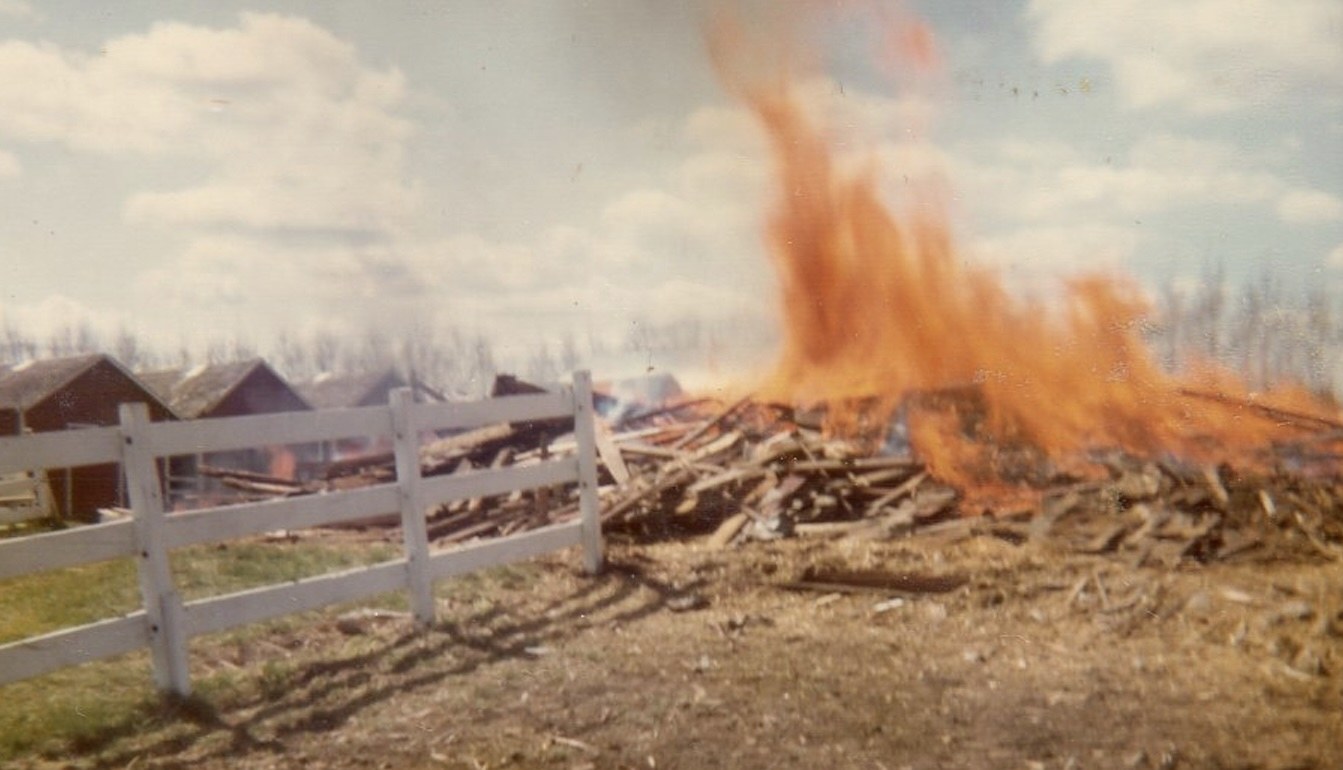
But my time is over, my work is done, my usefulness is gone. I have no sad regrets. I only hope my present owner will spare me from a fiery, fiery end.
My boards and timbers are still useful, at least some of them. I wish I could live on somehow, as a granary, or perhaps a cattle shed—yes, maybe a cattle shed, another kind of barn, that is what I would like to be. It is no dishonour to be a barn, you know. The Greatest Teacher in all the world was born in one. Always remember that.
· · ·
· · ·